Winter Walks Along the Frozen Canals of St. Petersburg
Discover safe winter walks along the frozen Neva River and St. Petersburg canals. Explore ice, bridges, and granite embankments on foot.
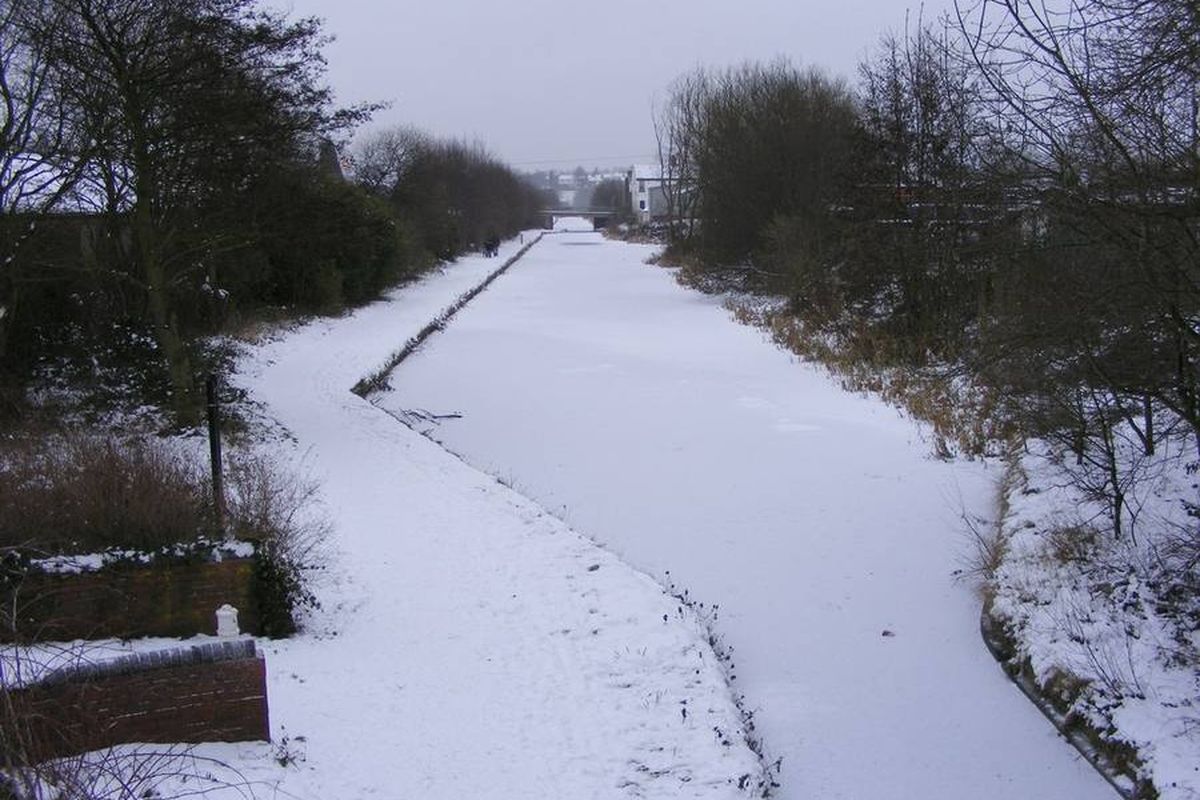
St. Petersburg's Frozen Waterways in Winter
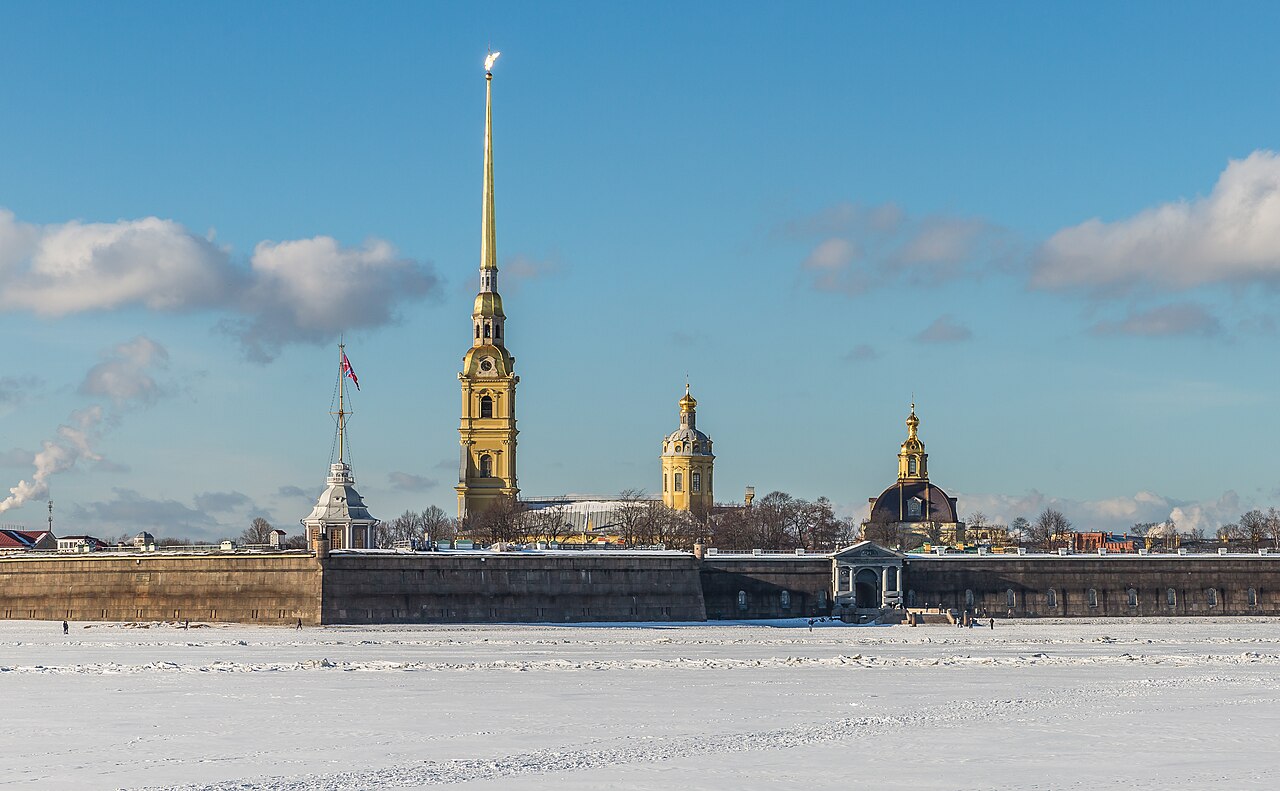
Photo: Ninara from Helsinki, Finland / CC BY 2.0 / Wikimedia Commons
How the Neva River Freezes Each Winter
Each winter, the frozen Neva River becomes a characteristic part of St. Petersburg's winter canal scenery. Freezing starts in early December when nighttime temperatures consistently fall below zero. The shallow connecting waterways ice over first. The Moika Canal and Griboyedov Canal typically form a solid surface by mid-December, and the Fontanka River freezes in the final weeks of the month. The broad Neva itself usually locks up in late December or the first days of January, depending on that year's cold snaps. Ice development follows a clear progression. A thin skim appears on calm water, then slush and snow mix freeze into a soft layer. Repeated cold cycles compress this into hard ice. By January, the frozen Neva reaches 20 to 30 cm thick in side channels, growing to 40 or 50 cm by February peak. This sturdy cover supports local Russian traditions of walking on the ice, though only on marked routes. Icebreakers operate throughout the season to keep vital channels open. These vessels cut paths near the river mouth and around the port, preventing a complete freeze of strategic lanes. Their daily work means the frozen Neva is never fully solid at the shipping approaches, so the city keeps both its winter look and working transport routes. As February ends, thaw sets in. St. Petersburg's canal ice thins quickly, and by late March the waterways break up entirely, ready for spring navigation. If you are planning a trip around this ice, run your dates through a cheap-flight search early, because the window between a solid freeze and the March thaw is shorter than it looks.
The Canal System of Fontanka, Moika, and Griboyedov
In the 18th century, as St. Petersburg took shape on the swampy delta of the Neva, engineers dug a network of canals to drain the land, move goods, and defend the new capital. The Fontanka began as a left branch of the Neva, later carved into a formal boundary. The Moika was built to supply fresh water and float timber, while the Griboyedov Canal linked the Moyka to the Fontanka, creating a ring of waterways. These canal routes were practical arteries before they became scenic promenades.
By the late 1700s, the city faced each bank with solid granite embankments. These low walls prevented erosion, and they also framed the ice with crisp geometric edges, turning each frozen surface into a mirror set in stone. When the temperature drops, the granite holds the ice in place and gives winter walkers a clear path beside the water.
The Fontanka in winter is broad and calm. Its wide sheet of ice often stays solid for weeks, a favorite spot for those curious about walking on ice, Russian style, though caution is needed near currents. The Moika canal narrows through the historic center, its ice usually capped with a thin snow layer that softens the granite's hard lines. The Griboyedov Canal's ice is the most delicate: a slender ribbon winding past pastel facades, where the current leaves swirls frozen beneath a glassy top.
Together these canals show a quieter side of the frozen river system, inviting slow winter walks away from the main stream.
How Frozen Waterways Shape St. Petersburg Winters
Each winter, the frozen river and the surrounding canals become a centerpiece of local life. Residents treat the ice as an extension of the street, continuing a long tradition of walking on ice in Russia that dates back centuries. Families cross from one bank to another on foot, children slide along the edges, and vendors set up near popular routes. The cold season is not a hardship but a familiar rhythm that belongs to the city's identity. The visual change is striking. The ice on the shallower canals turns a bright white, while deeper sections show blue shadows beneath the surface. The Fontanka River in winter has the same quiet contrast, with snow piled along the embankments and bare trees reflected in the frozen sheet. Photographers and ordinary strollers alike pause to take in the stillness that replaces moving water. In summer these same waterways host constant boat traffic, from tour vessels to private launches that fill the channels from dawn to dusk. The frozen months reverse that scene completely. Instead of engines and wakes, the St. Petersburg canals in winter offer a silent path where footsteps and skate marks are the only signs of motion.
Safe Ice Walking in St. Petersburg
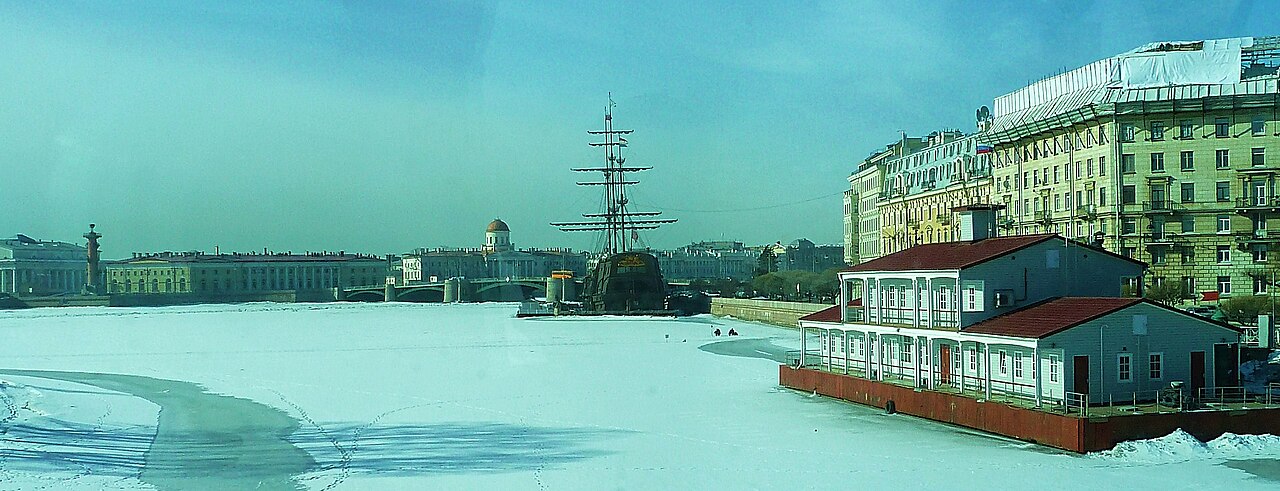
Photo: Pierre André Leclercq / CC BY 4.0 / Wikimedia Commons
Ice Safety Rules for Walking on St. Petersburg Ice
Walking on the frozen Neva and across St Petersburg canals in winter can be enjoyable, but only when the ice meets strict safety thresholds. In Russia, rescue services advise that clear, solid ice should be at least 10 centimeters thick for a single pedestrian and 15 centimeters for small groups. Anything thinner than 7 centimeters will not support an adult, and vehicles need over 20 centimeters. Before stepping onto any frozen surface, check local bulletins that report measured thickness at popular spots like the Fontanka embankments or the Moika. Color is a reliable indicator of strength. Newly formed clear blue or greenish ice is denser and safer than white opaque ice, which contains air bubbles and is weaker. Avoid large grey or dark patches, as these signal thawing or thin ice near currents. Snow cover is deceptive: a layer of snow insulates the ice beneath and hides cracks, making it harder to judge thickness. Fresh snow on top of weak ice commonly causes people to fall through. Always test ahead with a pole and avoid snow-covered stretches unless verified by recent measurements. Local authorities in St Petersburg ban foot traffic in zones where the ice is unreliable. These typically include areas near drawbridges, shipping lanes, and fast-flowing sections of the Griboyedov Canal. During mild spells, city services close the central frozen stretches and put up signs forbidding walking on the ice without permission. Police may fine violators near the Neva's main channel. Stick to marked routes and obey posted restrictions to stay safe while enjoying the winter scenery.
Recommended Walking Spots on the Fontanka River in Winter
The Fontanka River in winter has some reliable public embankment stretches with stable ice inside St. Petersburg. When temperatures stay below -10 C for at least five consecutive days, the water between Belinsky Bridge and Lomonosov Bridge freezes to a depth of 20 to 30 centimeters, enough for careful walking. Municipal crews mark these zones with flags, and the frozen river system connects to smaller channels here, making the canal network a practical destination rather than a remote trek. Access points near Lomonosov Bridge are the easiest way down to the ice. A wide granite staircase on the northeast corner of the bridge goes straight down to the frozen surface, and a second ramp sits 150 meters downstream near the former barge station. Early risers often start walking here before the midday crowds, following the packed path toward the canal mouth. From the bank the views of frozen waterways are just as rewarding. Standing on the Fontanka embankment near Lomonosov Bridge you look west to see the Griboyedov Canal ice locked under snow, while the frozen surface reflects the ochre and grey facades of 19th century buildings. The Neva itself is visible farther north beyond the Field of Mars, completing a quiet white panorama across the city's historic center.
Moika Canal and Griboyedov Canal Ice Access
The Moika canal is a calm place to start winter walking in the city. Near the Engineer's Castle, the canal embankment drops to a set of granite steps where locals test the ice before stepping out. When the deep freeze sets in by late December, this stretch has little current, so people often choose it for a first walk on frozen water. The canal surface here is usually thick by mid-January, but check for 10 centimeters of clear ice before leaving the bank. Further east, the Griboyedov Canal attracts visitors behind the Kazan Cathedral. The canal runs along the cathedral's rear wall, and a small descent near the eastern fence lets you reach the ice sheet. This stretch often lines up visually with the Fontanka farther downstream. The surface is smooth and wide, fine for a short walk, though snow can hide weak spots near the edges. Be careful around bridges and moving water. Both canals have slight currents under the ice, especially near bridge pillars like those of the Bank Bridge or the Blue Bridge. Stay at least five meters back from any support structure. The Neva may look solid from afar, but walking on the ice requires respect for hidden flows. Go with a companion and carry ice picks.
Scenic Neva River and Bridge Views
Best Bridges for Viewing the Frozen Neva River
Palace Bridge sits in the center of St. Petersburg where the frozen Neva River forms a wide sheet of ice reaching toward the Admiralty. In deep winter the main channel freezes into a pale expanse, and from the bridge deck you can look down the frozen course that once carried barges and imperial boats. Early morning light makes the ice a soft blue, with granite embankments on both sides framing the view. Locals use the lower steps near the bridge to reach the edge of the ice, though the current under the ice stays strong and the center channel is never safe to walk on without official clearance. The bridge's open spans also show the wider bend where the river meets the Gulf of Finland fog. Stay on the marked banks and use the railing as your photo line. The frozen river from Palace Bridge is the classic postcard view, but it is also the most crowded by 10 am, so arrive before the tour buses. Ice conditions change daily, so check the ice report posted near the bridge guard post before you step down. Troitsky Bridge gives a different sightline. From its length you see the river bend toward the Peter and Paul Fortress, with the fortress spire rising over the white field. The steel arches of Troitsky divide the view into clean sections, and the far side shows the Krestovka and the start of the Fontanka's flow, which stays only partly frozen near the mouth. Photographers favor the northeast end of Troitsky at sunset when the ice takes on the pink of the fortress walls. The bridges of St. Petersburg act like photo frames. Each span captures a slice of the frozen river or a linked canal. The Moika and Griboyedov canals sit just off the main river, and from smaller footbridges you see the narrow frozen strips between yellow buildings. A walk from the Neva down the Griboyedov shows how the St Petersburg canal network connects. Bring a wide lens and shoot through the arch, not over it.
Icebreakers at Work on the Neva
St. Petersburg keeps the frozen Neva River open for travel with a small fleet of icebreakers. The city runs several diesel-electric vessels including the Sankt-Peterburg and the Moskva, both built in the 1960s and still working. Smaller harbor tugs with reinforced hulls cover the narrow winter sections of the Fontanka River and the other central canals, while compact cutters that turn in tight spaces usually break ice in the Griboyedov Canal. These boats do not remove all ice. They open lanes so emergency and supply traffic can move, and they keep the ice sheet stable near the banks where people walk. During a hard freeze the same breakers patrol the canal network to stop pressure ridges from damaging building foundations. Visitors walking on ice in Russia should watch the lanes these ships leave, because freshly broken water refreezes slowly and stays thin for days. The fleet keeps a fixed early morning breaking schedule. Crews generally start around 05:00 in the lower Neva and finish the central reaches by 08:00 before pedestrians appear. On cold weekends a second pass runs near 14:00 on the Fontanka. Spectators should stay at least 50 meters from any active breaker and off ice within 20 meters of a moving ship, since suction and falling chunks make the edge dangerous.
Granite Embankments and Winter Photography
The granite embankments of the frozen river turn into a wide mirror when the winter sun sits low. Around 9 am and again near 3 pm the light rakes across the stone at a shallow angle, so the pale blocks pick up a warm tone and throw it back onto the ice. On clear days the surface of the St Petersburg canals in winter looks like a single sheet of polished metal. The effect is strongest on the Neva's straight runs between the Admiralty and the Winter Palace, where nothing blocks the reflection. Photographers who arrive early find the granite still dusted with frost that catches the first light and adds texture to wide shots of the waterway. A thin haze over the water at those hours softens the far bank and keeps the exposure manageable without filters. Walk the Fontanka edge near the Summer Garden and you get the same low-sun bounce on a narrower channel, good for tighter frames. The Moika and Griboyedov both sit lower than the Neva, so their embankments catch shadow sooner, but the granite still glows for about forty minutes after sunrise. Bring a cloth to wipe condensation from your lens because the cold air meets warm camera glass fast. For blue hour the best window is the twenty five minutes after the street lamps switch on, roughly 4.15 pm in December, when the bridges are lit and the ice holds a deep blue cast. Set your tripod on the wide granite ledges near Palace Bridge or the spit of Vasilievsky Island for a steady frame of the frozen river with the Rostral Columns in view. The embankment steps also give a low tripod angle that keeps walkers out of the shot.
Plan Your Winter Walk Itinerary
Half-Day Walking Route Along the Canals and Neva
A practical half-day route begins at the Fontanka River, where winter freezes the wide waterway into a pale sheet edged by 18th-century embankments. From the Fontanka's Anichkov Bridge area, walk west along the Moika Canal for about 1.2 kilometers. It freezes solid by late December in most years, and its low railings give clear sightlines to the broad frozen river at the western end. Take your first break at the Field of Mars, a 10-minute detour that opens onto the Moyka's quieter eastern stretch. Coffee stands near Mars Square sell hot tea for around 80 rubles and give your hands a rest from the cold. Continue to the Moika's mouth where it meets the Neva near the Winter Palace. This stretch is the best place to stand on the canal ice and look across the broad frozen river toward Vasilyevsky Island. The round-the-clock Bronze Horseman viewpoint sits 400 meters south and makes a good second pause. Total walking distance is roughly 3.5 kilometers and takes 2.5 to 3 hours with stops. The Griboyedov Canal ice near Kazan Cathedral adds a final 700-meter segment if time allows, with its colored bridge lights visible by mid-afternoon. Wear crampons on Fontanka surfaces because refreeze after thaws leaves uneven patches. Local vendors rent spikes near each bridge for 150 rubles a day. Walking on ice in Russia demands checking the day's temperature trend, so ask your hotel concierge before leaving whether that stretch has been declared safe that morning.
What to Wear for Cold Weather and Ice
Dressing for a day on the frozen river and St Petersburg canals means building layers that trap heat but let sweat escape. Start with a merino wool or synthetic base layer, add a fleece or down mid layer, then pull on a windproof shell. Wind off the ice cuts through cotton jackets fast, so the outer shell is not optional. On the Fontanka's winter banks and its open stretches, a hat, neck gaiter, and insulated gloves keep fingers and ears from numbing within minutes. Thick wool socks inside waterproof boots complete the base setup. When you move to standing on Griboyedov Canal ice, foot grip becomes the real safety factor. Strap ice cleats onto your boots before stepping onto any frozen surface. A telescoping pole helps you test ice thickness and keeps balance on uneven frozen plates. Local walkers on ice-walking routes often carry two poles for longer hauls across the Neva mouth. Pack a small emergency whistle on a cord around your neck. If you slip near a weak seam in the ice, three short blasts carry farther than shouting. Keep your phone in an inside pocket, not the outer shell, so the battery does not die in the cold. A charged phone with offline maps of the canal network is your backup if weather closes in.
Local Tips and Preservation Rules
Locals in St. Petersburg know the river and canals show their best winter scenery early in the week. From Monday to Wednesday morning there are far fewer visitors than on weekends, when tour groups fill the embankments. Walking the Fontanka stretch near Fontanka 59 on a Tuesday at 9am often means you have the ice views almost to yourself. Photographers and quiet walkers like these times because the light is flat and the surface stays undisturbed by crowds. Start before 11am, since afternoon sun weakens the top layer and more people come after lunch. The Griboyedov canal ice near Kazan Cathedral is especially calm on weekday mornings and gives a clear view of the frozen waterway without a crowd. That canal also freezes solid but gets busy near the Hermitage on weekends, so on Thursday or Friday use the quieter middle sections. Local etiquette matters as much as timing. The granite barriers along the canals and Neva embankments are historic structures from the 1700s and are not for climbing. Stepping on the low walls to reach the ice or take a photo damages the stone and risks a fall through unstable edges. Use the marked safe zones where city crews have tested the ice thickness and posted signs. Walking on ice here means respecting these limits, because unmarked areas near bridges or currents can be under 10cm thick. The Fontanka and Moika canal both have designated entry points near popular stairs, and the Griboyedov ice is monitored between Sadovaya and Bankovsky bridges. Follow the flagged paths, stay off the barriers, and the frozen Neva river stays safe for everyone on the winter walk.
Official sources
Details worth verifying before you go — checked against:

Travel Writer & Editor
Emily Johnson writes and edits Do Travel Blog. Every guide on the site starts the same way: with a question she actually had while planning — when to book, which pass to buy, how to get from A to B without overpaying. Where a number matters, she cites the source: park tickets link to the park's own fee page, visa rules to the official consulate, ferry times to the operator. Prices get re-checked against those pages before each update, and a guide is re-dated when its numbers move. Nothing here is sponsored — she doesn't accept payment for coverage. Spotted something stale or wrong? Email hello@dotravel.blog and she'll fix it.