Snow-Covered Palaces: St. Petersburg's Winter Architecture
Explore St. Petersburg palaces winter: snow-covered imperial architecture, Winter Hermitage, Catherine Palace, and Russian baroque facades.
St. Petersburg's Winter Architectural Heritage
How Snow Transforms the City's Imperial Skyline
When snow settles over St. Petersburg, the city's imperial facades undergo a quiet change. The white limestone and plaster walls of the Winter Palace and adjacent hermitage buildings, already pale, blend into the falling snow, so that the mass of the Winter Palace reads as a single sculpted volume. Colored facades respond differently. The sky-blue and white striping of the Catherine Palace becomes sharper, each snow-laden cornice drawing a clean line between pigment and ice. Similar effects appear across the city where ochre and terracotta walls meet a white roofline, proving that how snow interacts with color depends on base hue. Gilded elements create the most striking winter contrast. At the Hermitage, the gilded dome of the Small Hermitage and the gold window hoods catch weak sunlight, throwing warm reflections across the snow below. Peterhof in snow shows this logic at scale: the gilded samson fountain figures and gate ornaments glow against frozen drifts, a baroque statement of imperial wealth. Even modest gilded weather vanes on palace rooftops turn into bright punctuation marks above the muted white city. Winter light itself becomes an architectural tool. From late November to February, the sun stays near the horizon, raking across facades at a low angle. This reveals the geometry of the palaces, emphasizing column flutes, pediment triangles, and rusticated ground floors that summer glare flattens. The long shadows define the rhythm of bays and the curvature of architraves, letting viewers read the structural logic of neoclassical and baroque designs with unusual clarity.
The Legacy of Russian Architecture in Snow
Peter the Great founded St. Petersburg in 1703 with a clear goal: to build a European capital that would open Russia to the West. He rejected the wooden chaos of older Russian towns and demanded stone facades, straight canals, and symmetrical squares modeled on Amsterdam and Venice. That urban blueprint produced the palace skyline the city would later make famous, as the new pale buildings met the Baltic snow each year. The first great structures followed the baroque taste of the early 1700s. The Winter Palace, shaped by Bartolomeo Rastrelli for Empress Elizabeth, used lavish stucco, curved wings, and bright turquoise and gold. By the late 18th century, Catherine the Great steered taste toward neoclassical calm. Strict columns, triangular pediments, and muted stone replaced ornate excess. When snow falls, this evolution reads clearly: the soft mounds on baroque cornices contrast with the clean lines of classical porticos. The Hermitage and the Catherine Palace show how the two styles absorb snow differently, while Peterhof frames its fountains and gilded gates in white silence. Winter slowly became part of the imperial aesthetic rather than a season to endure. The long northern darkness and heavy snows simplified the visual field, letting mass and proportion dominate. Tsars staged ceremonies against snowy backdrops, and court painters recorded golden domes rising from white roofs. The contrast of gilded crosses and pale stone under a cold sun made the snowy capital a deliberate display of power. Over time, this meeting of snow and stone turned into a national image, a meeting of European form and northern climate that defined the city's identity for centuries.
The Winter Palace and Hermitage in Snow
Winter Palace in St. Petersburg: Facade and Palace Square
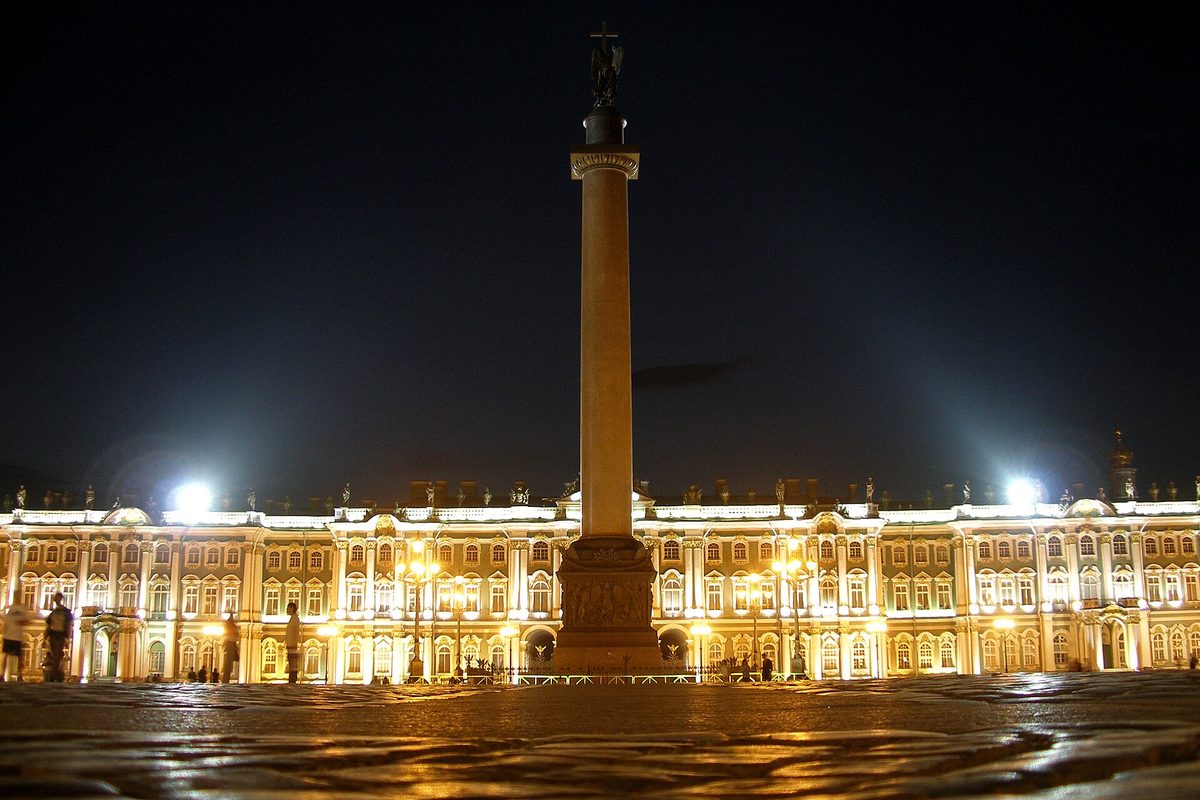
The Winter Palace in St. Petersburg has a green-and-white facade that looks striking under snow. The snow outlines the Baroque columns and window surrounds, and the contrast between the pale green walls and white decorative mouldings becomes clear. The Hermitage buildings adjacent share the same color scheme, though the main focus is the palace front. Palace Square lies before the palace and was used for imperial ceremonies and public events such as military parades. In winter, the vast cobbled expanse turned white and hosted troop reviews and official announcements, and the snow made the gatherings solemn. The square's design by Rossi framed the palace as the empire's center. Keeping the square and palace approaches passable was a constant task. Historical records show that hundreds of laborers were hired each winter to shovel snow from Palace Square so citizens could reach the palace and the nearby Hermitage. Horse-drawn carts removed the cleared snow to canals. This effort ensured that even in deep snow, the imperial seat remained accessible, unlike the seasonal isolation of Tsarskoye Selo or Peterhof.
Winter Hermitage: Snow-Covered Roofs and Statues
The Hermitage becomes a scene where imperial grandeur meets deep snow. Atop the Winter Palace, rows of sandstone statues and decorative vases line the roof ridges, and each snowfall adds a thick white cap. Accumulation can reach forty centimeters on the lee sides, weighing down the centuries old stucco. These rooftop sculptures, originally carved by 19th century craftsmen, become softened silhouettes, their facial features and drapery hidden until thaw. Snow accumulation matters for structure as well as looks. Each season, structural engineers calculate the load on the 18th century timber roof trusses. Snow-load guidelines from the heritage ministry specify maximum drift depths, and Hermitage staff use thermal imaging to detect frozen patches that could stress the stucco below. The museum's conservation team works through the freezing months to preserve the fragile exterior plaster. When temperatures drop to minus fifteen Celsius, moisture inside porous stucco freezes and expands, threatening hairline cracks. Hermitage technicians apply breathable water repellent coatings in autumn and monitor roof drainage to prevent ice dams. The museum keeps interior heating steady so adjacent structural elements do not shift, and workers remove snow from the statues by hand to avoid chipping. Visitor routes through the snowy courtyards follow cleared granite paths from Palace Square to the main entrance. Guides lead groups past snow piled against the lower columns, where white drifts contrast with green malachite interiors. A side walk along the Winter Canal gives a clear view of the palace rooftops dusted in snow, a sight that rivals Catherine Palace or Peterhof for photographic drama. Winter remains a peak season for those who value quiet halls and frosted facades.
Inside the Hermitage in Winter
The Winter Palace and Hermitage settle into a quiet pace when snow covers the city. Inside, climate systems protect masterpieces from the winter cold. Outside, the Russian architecture under snow looks pristine, but temperature swings threaten the paintings and gilded frames. Conservators keep the heat steady and run humidifiers to hold relative humidity near 55 percent year round. This prevents canvas shrinkage and mold during dry winter months when open doors let in cold air. The Hermitage keeps the collection safe for years to come.
Catherine Palace and Peterhof in Winter
Catherine Palace in Winter: Baroque Facade in Snow
The Catherine Palace in Tsarskoye Selo turns to frozen elegance when snow settles over its famous blue-and-white facade. This masterpiece of Russian architecture shows a striking contrast in snow: pale azure walls and white columns edged with frost, while gilded Baroque statues catch the low winter sun. The blue-and-white color scheme, devised under Empress Elizabeth, appears even more vivid against the snow. Such St. Petersburg scenes draw visitors who brave the cold for the luminous view. Inside, the legendary Amber Room offers warm contrast to the chill. Recreated from historic photos and fragments, the amber panels glow with honeyed light, their mosaics reflecting chandeliers. During Catherine Palace winter tours, guides note how the resin scent seems stronger in the dry cold season. Controlled heating preserves the delicate panels while snow piles on the roof. Beyond the palace, Tsarskoye Selo park winter walks reveal quiet grandeur. Formal gardens by Rastrelli and Cameron lie under snow. Paths around the Great Pond freeze into glassy tracks, and marble statues wear snow caps. Unlike busy summer months, a winter stroll feels private, with only boot crunches and occasional guests who came to see the architecture in snow at its most poetic. Nearby Peterhof awaits another day, but Catherine Palace holds its own frozen charm.
Peterhof in Snow: Fountains Frozen, Gardens Silent
When winter arrives, the imperial ensemble of Peterhof becomes one of the most striking examples of what the city offers in winter. Peter the Great built it as a summer residence, and when snow layers the rooftops and pediments with thick white frosting, its facades and pavilions look different. The gilded domes and baroque stonework stand quiet against the frozen Gulf of Finland, away from the busy tourist season. The Grand Cascade centers on the Samson fountain, which in summer sends a 20-meter jet of water up to mark Russia's victory over Sweden. Each November, workers drain and winterize the whole fountain system. They remove the Samson sculpture or wrap it in a protective wooden cover with an insulated frame so ice expansion and frost cannot damage it. The thundering water display turns into a silent, shrouded monument that waits for the thaw. Below the cascade, the Lower Park becomes a snow-covered scene that draws photographers from around the world. Bare trees line the frozen canals, and snow settles on the shoulders of marble nymphs and gilded vases. To capture Peterhof in winter, you need early light, when shadows stretch long and the yellow palace walls glow during the blue hour. This beauty differs from the Hermitage or the Winter Palace, where interiors stay warm and full of people. Off-season, Peter the Great's summer residence loses its courtly noise. The gardens fall silent, the fountains stop, and the Catherine Palace nearby in Tsarskoye Selo sits just as quiet. Visitors who come in deep snow see an authentic side of imperial design under cold conditions, a rare perspective on the endurance of these palaces.
Comparing the Two Imperial Retreats in Snow
When weighing winter experiences, Catherine Palace and Peterhof present clear contrasts in scale and style. Catherine Palace in Tsarskoye Selo is a Rococo residence with a compact blue-and-white facade trimmed in gold, where snow settles on ornate finials and creates a jewel-box effect. Peterhof, by contrast, is a Baroque ensemble spread across upper and lower gardens facing the Gulf of Finland. Its red-and-gold palace reads as monumental, and in winter the frozen fountains become silent white terraces. Accessibility in the cold months differs too. Catherine Palace winter visits rely on the commuter train from St. Petersburg's Vitebsky station, with heated interiors open daily except certain Mondays. Peterhof is reached by bus or suburban rail, since the summer hydrofoil stops; the lower park stays open for walking though the fountain mechanisms are shut. The Winter Palace and the Hermitage remain central and easy to combine, but the retreats demand half-day trips. Atmosphere separates them most. At Catherine Palace, winter brings a hushed intimacy, snow muffling the formal garden. At Peterhof, the vast expanse and Baltic wind give drama and isolation. Both show the architecture at its imperial best, but one feels like a private fairy tale, the other a frozen triumph.
Architectural Elements of Snow-Covered Palaces
White Facades and Stucco Decoration in Winter Light
The white facades of St. Petersburg palaces in winter gain sharp clarity when snow settles on ledges. In Russian architecture, snow coverage turns flat plaster into relief as stucco molding catches low light. Dentil courses, egg-and-dart friezes, and cartouches above gates become outlined in white, their shadows lengthening under the pale sun. The stucco molding details include floral bosses and military trophies that normally read as subtle shadow but become crisp white outlines against the sky. At the Winter Palace in St. Petersburg, frost traces the baroque stucco of window surrounds. At the Winter Hermitage, snow outlines scrollwork that decorators applied centuries ago. Caryatids at Catherine Palace in winter appear carved from sugar when snow fills their curls, and Peterhof reveals how sandstone balustrades were tuned for freeze cycles. The Winter Palace in St. Petersburg also shows frost outlining double eagles in the upper cornice, while lost putti figures hidden in warm months reappear as voids in snow. For Russia's cold climate, builders favored breathable construction. Limestone, brick cores, and lime-based stucco with hemp fiber let facades shed meltwater. This accounts for Russian architecture's snow resilience, as porous stone survives freezing. Traditional lime mortar flexed at minus thirty, a recipe masons still study to match the original fabric. Builders avoided modern cement that traps moisture; instead, breathable lime allowed water vapor to escape, preventing ice lens formation inside the wall. Restoration faces freeze-thaw pressure. Water enters cracks, expands as ice, and spalls ornament. Cycles can exceed eighty per season, widening fissures. Teams now use laser scans to map micro-cracks, then inject grouts. Replacing a damaged cornice at a snow-covered palace costs tens of thousands of rubles, needing summer scaffolds and autumn checks.
Baroque Architecture Against Snow
The baroque facades of St. Petersburg show a striking contrast when dusted with snow. Snow coverage turns heavy ornament into crisp relief, as gilded capitals and sculpted cornices seem carved from the same white ground. The ornate baroque forms, with their curved pediments and rhythmic columns, gain a graphic clarity in the cold season that summer foliage hides. At the Winter Hermitage and the neighboring Winter Palace, the sprawling ensemble is a study in tonal restraint. Snow fills the recesses of the elaborate stucco, leaving only the gold dome of the Admiralty and the amber hues of the palace windows to break the monochrome. A short distance south, the Catherine Palace shows a similar effect: the famous blue-and-gold exterior of Tsarskoe Selo, capped with snow, looks like a layered wedding cake of baroque excess frozen in time. Low winter sun deepens the scene through long shadows. In the early afternoon, the sun hangs barely above the Neva horizon, casting elongated shadows from pilasters and statue finials across the snow pack. This shadow play reveals the depth of carved stone details that flat noon light would wash out. The snow itself is a reflector, lifting shadow interiors and creating a soft glow that balances the hard edges. At Peterhof, the terraced fountains silent under ice benefit from the same raking light, the gilt statues throwing sharp lines onto the white parterres. The combination of ornate form and white ground makes the frozen city a photographer's subject. Snow takes part in the scene, smoothing the visual noise and letting baroque geometry show.
Historical Buildings and Their Winter Preservation
The imperial tradition of winter care for St. Petersburg palaces goes back to the 18th century, when crews of servants and artisans cleared snow from the Winter Palace in St. Petersburg and other royal residences. Russian architects built snow resilience into their designs. Steep roof pitches and durable copper sheathing helped shed accumulations. At the Winter Hermitage, logbooks record daily inspections during snowfall to prevent ice dams along the cornices. Modern conservation in extreme cold uses technology that did not exist in imperial times. Thermal imaging detects heat loss that melts snow unevenly, causing dangerous refreezing. At Catherine Palace and other winter sites, conservators apply breathable protective coatings to facades before frost arrives. Peterhof under snow needs special attention to its fountain pipes, which are drained and insulated to avoid burst damage when temperatures fall below minus 20 Celsius. Snow load on roofs remains a primary structural concern. Heavy wet snow can weigh over 200 kg per square meter, stressing the historic timber and masonry frameworks. Engineers monitor roof beams with sensors in real time, a practice that protects both the building and the visitors below. Regular removal by trained teams preserves the delicate plasterwork and prevents collapse, so these landmarks survive each harsh season. The continuity of winter upkeep across St. Petersburg palaces reflects centuries of adapted Russian building strategies for snow that balance aesthetics with safety.
Visiting St. Petersburg's Palaces in Winter
Best Spots to Photograph Russian Architecture in Snow
Photographing the palaces in winter requires planning around both weather and light. The city's imperial buildings wear a clean white coat for months, and the right vantage points make the difference between a flat snapshot and a frame worth printing. Start at Palace Square for a panorama that takes in the full scale of the Winter Palace St Petersburg facade. Stand near the center of the square, slightly offset from the Alexander Column, and use a wide-angle lens to avoid perspective distortion. On calm snowy mornings the ground reflects light back onto the lower walls, so expose for the bright facade rather than the sky. The winter hermitage wings extend to either side, and including their rows of columns shows the rhythm of the whole composition. From the Neva embankment you get a different angle on the same imperial frontage. Cross to the opposite bank near the Admiralty and shoot back toward the palaces with the frozen river in the foreground. This low viewpoint emphasizes the height of the buildings against the snowy sky. For variety, travel out to Peterhof and frame the grand cascade with ice sculptures behind it, or visit Catherine Palace in Tsarskoe Selo to capture blue-and-white exterior detailing under a fresh snowfall. Early morning light is the secret to white facades that glow instead of blow out. Arrive thirty minutes before sunrise when the sky turns pale lavender and the first sun rakes across stone reliefs. Side light from a low winter sun reveals the depth of cornices and statues, while the snow stays a soft neutral tone. Avoid midday when flat overhead light washes out the texture of the snow and leaves harsh contrasts on the ice.
Planning a Winter Visit to the Imperial Palaces
During the cold months, the palaces shift schedules to match shorter daylight. The Winter Palace opens Tuesday to Sunday from 10:30 to 17:00, with desks closing earlier. Mondays are closed. Suburban estates follow stricter patterns. Catherine Palace interiors often pause January to early February, but grounds stay open for snow photos. Peterhof in snow shows the same rule: the fountain park freezes and the grand palace may shut midweek, yet outer facades attract quiet viewers. Many travelers find that the limited hours let them enjoy empty halls and clean snow on facades. These limits protect the art and make the facades stand out against empty plazas. Dressing for these sites means preparing for temperatures below minus 15 Celsius. Wear an insulated coat, thermal layers, waterproof boots, hat and gloves. Public transport is reliable: take the metro to Admiralteyskaya for the Hermitage, then elektrichka trains from Vitebsky to Pushkin and Catherine Palace. Buses also run to Peterhof when snow blocks the harbor route. A practical plan combines city center with outskirts in one day. Start at the Winter Palace, spend two hours inside, then go to Catherine Palace for a garden walk. This saves time and shows how imperial design meets the season. Visitors who prefer fewer crowds can book combined tickets online and skip summer lines completely.
Official sources
Details worth verifying before you go — checked against:

Travel Writer & Editor
Emily Johnson writes and edits Do Travel Blog. Every guide on the site starts the same way: with a question she actually had while planning — when to book, which pass to buy, how to get from A to B without overpaying. Where a number matters, she cites the source: park tickets link to the park's own fee page, visa rules to the official consulate, ferry times to the operator. Prices get re-checked against those pages before each update, and a guide is re-dated when its numbers move. Nothing here is sponsored — she doesn't accept payment for coverage. Spotted something stale or wrong? Email hello@dotravel.blog and she'll fix it.