Top Cultural Experiences on a Morocco Desert Tour
Discover the top cultural experiences on a Morocco desert tour: Berber village visits, camel trekking, souks, and historic kasbahs. Explore 8 days of authentic Berber culture itinerary.
Embracing Morocco's Rich Heritage on an 8-Day Desert Journey
The most rewarding cultural experiences on a Morocco desert tour are not just the dunes but the layers of history woven into Berber villages, ancient kasbahs, and bustling souks. This 8-day Morocco Berber culture itinerary begins in Marrakech, crosses the High Atlas Mountains through the Tizi n'Tichka pass, explores the kasbahs of the Dadès Valley and Todra Gorge, ventures into the Sahara near Merzouga, and returns through the Draa Valley and Ouarzazate.
Along the way, you will gain practical insights into Berber hospitality, such as sharing mint tea with a family in a remote mountain home or helping prepare a traditional tagine. The Marrakech souks offer a sensory overload of spices, textiles, and handcrafted metalwork, while camel trekking Morocco culture comes alive during a sunset ride across the Erg Chebbi dunes. Each stop reveals a distinct facet of desert life, from the intricate mud-brick architecture of Aït Benhaddou to the lively weekly market in Rissani.
This journey is designed to immerse you in the everyday rhythms of the Sahara, from sleeping in a tented camp under a blanket of stars to bargaining for leather goods in a labyrinthine souk. By the end, you will understand why the cultural experiences on this Morocco desert tour are as memorable as the landscapes themselves.
Exploring Historic Kasbahs and Desert Fortresses
Ait Benhaddou - A UNESCO World Heritage Kasbah
Ait Benhaddou is the most iconic ksar along the former caravan route linking Marrakech to the Sahara, and a highlight of any cultural Morocco desert tour. This UNESCO World Heritage Site rises from the Ounila Valley with its distinctive red-ochre earthen walls, a striking example of traditional Berber architecture that has stood for centuries. The fortified village, or ksar, was once a crucial stop for traders transporting salt, gold, and slaves across the desert, and today it offers travelers a window into Morocco's pre-Saharan history.
The architecture of Ait Benhaddou is a masterclass in local building techniques. The structures are made from sun-dried clay bricks and a polished plaster called tadelakt, which gives the walls a smooth, waterproof finish. Defensive towers with crenellations and corner turrets punctuate the ksar, while the thick walls keep interiors cool in the intense heat. This construction method is deeply tied to the region's Berber heritage. The ksar's layout, with narrow alleys and communal spaces, reflects a social organization that prioritizes security and community.
Beyond its architecture, Ait Benhaddou has gained international fame as a film location. Its dramatic silhouette has appeared in Hollywood blockbusters such as Gladiator, where it stood in for the Roman provinces, and in Game of Thrones as the city of Yunkai. The ksar's photogenic quality has made it a favorite set for directors seeking a timeless desert fortress. As you walk through the labyrinthine alleys with a local guide, you can spot the exact spots where scenes were filmed, adding a layer of cinematic magic to the historical experience.
A guided walk through the ksar's narrow passageways is essential for understanding its complex layout. A local guide will point out the communal granary, the mosque, and the intricately carved doorways that mark different family properties. They explain how the ksar's inhabitants managed water storage and defense, and how the village has adapted to tourism while preserving its traditions. This guided walk forms a core part of the cultural Morocco desert tour, complementing the camel trekking Morocco culture encounters in the Sahara. It also provides context for the Marrakech souks, where similar Berber craftsmanship is on display in pottery, carpets, and jewelry.
The Kasbahs of the Draa Valley
The drive south from Ouarzazate into the Draa Valley is one of the most scenic stretches of any cultural Morocco desert tour. The road cuts through a dense palm oasis that stretches for 200 kilometers, with thousands of date palms irrigated by the Draa River. On either side rise the crumbling mudbrick kasbahs that once guarded the trans-Saharan trade routes. These fortified villages were more than military posts; they were customs houses, caravan stops, and centers of power where merchants exchanged salt, gold, and slaves.
Kasbah Tamnougalt, near the town of Agdz, is one of the best-preserved examples. Built in the 17th century, it served as the residence of the Glaoui family, who controlled the trade corridor for generations. Today, visitors can walk through its labyrinthine rooms and courtyards, sometimes meeting a descendant of the Glaoui dynasty who still lives on site. They share stories of the family's influence and the kasbah's heyday, offering a personal connection to the region's history.
For photographers, late afternoon light transforms the kasbahs. The golden hour casts a warm glow on the rammed-earth walls, bringing out their rich terracotta tones. Shoot from across the oasis to capture the contrast between the green palms and the fortified mudbrick, or frame the kasbah against the bare desert hills. This stop on the Morocco Berber culture itinerary rewards early risers and sunset wanderers alike.
Todra Gorge - Natural Beauty and Berber Villages
Todra Gorge, carved by the Todra River through the High Atlas Mountains, is a dramatic corridor of towering limestone cliffs that rise nearly 300 meters on either side. The narrow canyon, barely 10 meters wide at its narrowest point, has been a natural passage for Berber communities for centuries. For travelers, this geological wonder offers a tangible connection to the landscape that has shaped local life.
Hiking through the gorge reveals more than just stunning rock formations. The trail winds past small Berber settlements where families tend terraced fields using water from the Todra River. These villages, with their mud-brick homes and clusters of date palms, feel untouched by time. Many routes lead to traditional irrigation systems known as khettara, underground channels that direct glacial meltwater to crops without evaporation loss. This ancient engineering, still in use today, is a highlight of cultural experiences Morocco desert tour itineraries that seek authentic rural life.
An overnight stay in a family-run guesthouse just outside the gorge transforms the visit into an immersive cultural encounter. Guests gather on rooftop terraces overlooking the cliffs as the sun paints the limestone in shades of amber and rose. The evening meal is a home-cooked affair: a fragrant lamb tagine with prunes and almonds, followed by sweet mint tea. The host family often shares stories of Berber traditions and the seasonal rhythms of the gorge, making this one of the most memorable stops on any camel trekking Morocco culture route or Marrakech souks journey.
Berber Village Life and Hospitality
Visiting a Berber Village in the High Atlas
Stepping into a High Atlas village means entering the world of the Amazigh people, the indigenous inhabitants of North Africa. Their language, Tamazight, has its own script (Tifinagh) and is spoken alongside Darija Arabic in daily life. Here, the rhythm of the day is set by the sun and the season.
Morning begins with bread: flat, round loaves baked in a communal clay oven fired by argan wood. Women knead the dough at dawn, and children often help shape the rounds before the baker sets them to rise. Meanwhile, goats clatter up the rocky hillsides, tended by a village elder or a young shepherd. The sound of their bells and the scent of baking bread drift through the alleys.
By mid-afternoon, the most important ritual begins: the preparation of mint tea. The host pours boiling water over gunpowder green tea and fresh mint, then lifts the pot high to create a frothy head. The tea is poured three times, each glass a different strength. Refusing a glass is considered impolite, as the offering is a gesture of welcome and trust. Visitors should accept with a smile and sip slowly.
If you wish to take photos, always ask first, especially of women and elders. A small gift (sugar, dates, or school supplies for the children) is appreciated but never expected. This genuine hospitality is one of the most memorable cultural experiences a Morocco desert tour offers, and it connects you to a way of life that has remained unchanged for centuries.
Traditional Berber Music and Dance
Music and dance form the rhythmic heart of Berber hospitality, and the Ahwash and Guedra are two of the most captivating performances you will encounter on any cultural experiences Morocco desert tour. Ahwash is a collective dance performed by entire villages, where men and women form lines, clapping and chanting in call-and-response while the bendir (a frame drum) and the gimbri (a three-stringed bass lute) set the tempo. The Guedra, by contrast, is a hypnotic solo dance from the Sahara, its movements guided by the plaintive notes of the nay flute. Each rhythm carries deep meaning, accompanying celebrations, weddings, and seasonal festivals that mark the passing of the year.
To experience the most authentic music of the desert, a stop at Khamlia Gnawa village is essential. This small settlement near Merzouga is home to Gnawa musicians who blend sub-Saharan trance rhythms with Berber melodies. Their all-night performances, powered by the clanking of metal castanets (qraqeb) and the throbbing gimbri, create an atmosphere that no visitor forgets. On a camel trekking Morocco culture journey, you may also encounter spontaneous drum circles around the campfire, where the bendir's steady pulse invites everyone to join in. These moments transform a simple tour into a living connection with Berber traditions, and they are why the Marrakech souks feel even richer after hearing the music that inspired them.
Staying in a Desert Camp with Berber Hosts
Near the towering dunes of Erg Chebbi, travelers choose between luxury desert camps with plush bedding and en-suite bathrooms or traditional nomadic-style camps with simple carpets and lantern-lit tents. The latter offer a more authentic connection to the landscape, where Berber hosts prepare meals over an open fire and guests sleep on thick mattresses under heavy wool blankets. Both options provide a genuine cultural experience on a Morocco desert tour, but the traditional style aligns more closely with an emphasis on everyday life over modern comforts.
As darkness settles over the Sahara, the campfire becomes the center of the evening. Berber men share stories of desert journeys, local legends, and the history of their nomadic ancestors, their voices carrying across the still sand. Guests sit on cushions around the fire, sipping sweet mint tea while a tagine of lamb, apricots, and almonds simmers in a clay pot. The couscous, fluffy and steamed with vegetables, arrives alongside preserved lemons and olives. This shared meal, cooked over the fire, mirrors the hospitality that defines Berber culture.
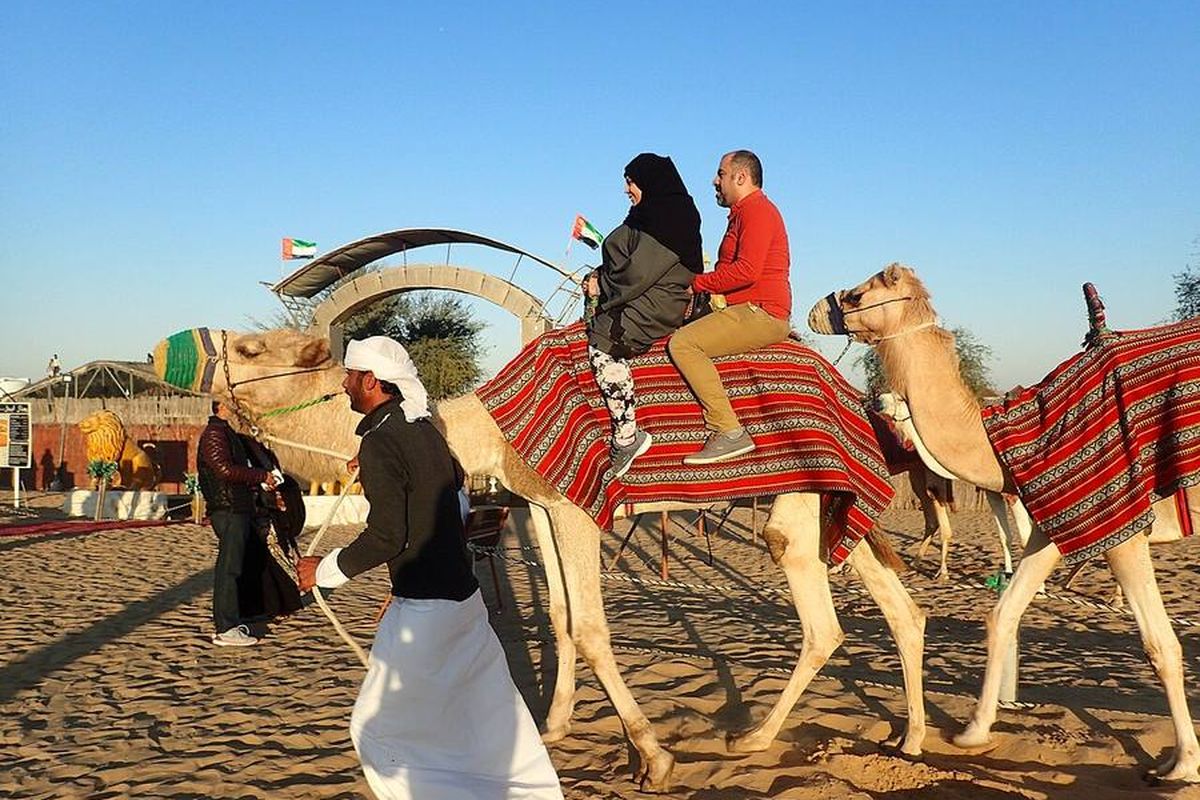
Before dawn, a gentle knock signals the start of the morning camel trek. Each guest climbs onto a single-humped dromedary as the caravan lurches into motion, heading toward the highest dunes. The sun rises slowly, painting the sand in shades of orange and rose. The quiet rhythm of the camel's stride and the vast emptiness of the desert create a moment of profound stillness. This camel trekking Morocco culture experience, guided by a Berber host, is a highlight of any Marrakech souks and desert itinerary.
Camel Trekking into the Sahara
The Camel Trek Experience - More Than a Ride
Mounting a dromedary is a gentle initiation into the desert. As the camel rises from its knees in a lurching motion, you grip the saddle and lean back, then settle into a steady, swaying gait. The animal's broad feet pad silently across the sand, and the rhythmic motion soon becomes meditative. This is not a fast ride, but that is the point: the pace forces you to slow down and absorb the vast, silent landscape.
For Berber nomads, the camel is a lifeline, not a tourist attraction. These animals have carried families, water, and trade goods across the Sahara for centuries. Their milk provides sustenance, their wool is woven into tents and blankets, and their dung is burned as fuel. Understanding this deep connection makes the camel trek a highlight of the trip.
To stay comfortable, wear loose long pants, a long-sleeved shirt, and sturdy closed-toe shoes. A wide-brimmed hat and a scarf for the face protect against sun and wind. Bring sunscreen and at least one liter of water. Along the trek, your guide may pause at a high dune for sandboarding, offering a brief thrill, or lead a short hike to a viewpoint where the orange horizon stretches endlessly. These small additions turn a simple ride into a full cultural experiences Morocco desert tour moment.
Camping in the Erg Chebbi Dunes
As the sun sinks below the horizon, the Erg Chebbi dunes shift from golden to deep amber. The camp staff, local Berber guides, have set up a collection of goat-hair tents in a sheltered hollow. The transition from day to night is abrupt: within minutes, the temperature drops and the desert falls silent. This is the moment when a cultural experiences Morocco desert tour becomes something intimate and timeless.
After dinner, the campfire is the center of the evening. Berber guides bring out drums and begin a rhythmic call-and-response song. Singing and handclapping follow, with stories of camel journeys across the Sahara and tales of the nomadic tribes that once roamed these sands. This is genuine Berber hospitality, not a tourist show. The music fades around midnight, and the real spectacle begins overhead.
With no light pollution, the Milky Way arcs across the entire sky. A guide points out the North Star, Cassiopeia, and the visible planets. Astronomy becomes a shared experience, linking the group to the ancient travelers who navigated by these same stars.
Before dawn, a gentle knock on the tent flap wakes you for the final adventure. You mount the camels for a second ride, climbing the highest dune as the first light creeps over the Algerian border. The early start is demanding, but it rewards you with a sunrise that changes every second and stays with you forever.
Navigating the Souks of Marrakech
The Souks - A Cultural Marketplace
Stepping off the sweltering Jemaa el-Fnaa square into the souks is like entering a different world. The main artery, Rue Semmarine, funnels you into a maze of narrow alleys that branch into distinct craft quarters. Each turn reveals a new trade: the hammering of metalsmiths in the brass and copper section, the earthy scent of tanneries, and the brilliant piles of wool in the carpet souk.
The craftsmanship zones are a living museum of Moroccan art. In the metalsmiths' quarter, artisans engrave trays and lanterns by hand, a skill passed down through Berber and Arab families for centuries. Carpet weavers display flatweave Beni Ourain rugs and intricate Rabat carpets, many woven by Berber women in the Atlas Mountains. Wood carvers shape cedar into intricate geometric patterns, using traditional techniques visible in the doors of historic medersas.
Haggling is expected, but it is a respectful dance. Start by offering about half the asking price, and let the merchant guide the negotiation. A smile and a few words of Darija - 'salam alaikum' and 'shukran' - go a long way. If the price does not meet your budget, walking away is acceptable; the merchant may call you back with a lower offer.
Do not miss Souk Semmarine, the widest souk street, lined with textiles and leather goods, and Souk des Teinturiers, where dyers dip skeins of silk into bubbling cauldrons of saffron, indigo, and henna. These vibrant stalls are a photographer's dream and a highlight of any cultural experiences Morocco desert tour itinerary. For travelers, the Marrakech souks offer a direct connection to the artisanal traditions that define the region's identity.
What to Buy - Authentic Moroccan Crafts
The labyrinthine souks of Marrakech overflow with crafts reflecting centuries of Berber artistry. Handwoven Berber carpets dominate the stalls: flat-woven kilims in tribal patterns, and Boucherouite rugs from recycled fabric, a modern innovation by rural weavers. These carpets offer a direct link to the nomadic traditions of the region, with each piece displaying signature motifs of tribes like the Beni Ourain or Azilal.
Pottery from Safi and Fes is equally distinctive. Safi produces earthy tagines, while Fes is famous for blue-and-white ceramics and zellige tiles. Leather goods from the tanneries, including soft babouches and poufs, showcase a dyeing process unchanged for centuries. Navigating the Marrakech souks for these items is a sensory journey. Negotiating for a kilim or a tagine is a cultural experience as authentic as the camel trekking Morocco culture that defines the desert tour.
Spice merchants offer saffron, cumin, and ras el hanout, while argan oil cooperatives sell culinary and cosmetic oils. Traditional cosmetics like black soap and ghassoul clay make excellent souvenirs. These purchases are a meaningful part of the cultural experiences Morocco desert tour, connecting travelers to the artisans and traditions of the region.
Culinary Traditions of the Desert
Traditional Moroccan Food Along the Route
Food is the heartbeat of any cultural experience on a Morocco desert tour, and the 8-day route delivers an edible map of Berber and Moroccan traditions. Each meal tells a story of ingredients shaped by the Sahara and the Atlas Mountains, from slow-cooked tagines to the bread that accompanies nearly every dish.
Tagine variations appear at nearly every stop. Chicken with preserved lemon and olives is a specialty in the foothills near the Dades Gorge, while lamb with prunes and almonds signals a celebratory meal in the desert camps. The conical clay pot traps steam, producing meat so tender it falls from the bone. Along the route, you will taste these dishes in family-run guesthouses and under star-lit tents after a day in the dunes.
Couscous is the Friday staple, prepared by Berber families with a reverence that borders on ritual. The semolina is steamed three times over a broth of lamb, seven vegetables, and turmeric, then fluffed by hand. On a desert tour, the weekly couscous lunch at a Berber home in the Todra Gorge offers a genuine window into local life, not a tourist show.
Street food in Marrakech souks and desert towns reveals a different side of Moroccan cooking. Msemen, a flaky square pan-fried bread, is sold by vendors for a few dirhams, often drizzled with honey or stuffed with minced meat. Harira, a tomato-based lentil soup with chickpeas and cilantro, warms the evening air during Ramadan or any cool desert night. Grilled skewers of kefta (spiced minced lamb) sizzle over charcoal, served with a sprinkle of cumin and salt.
Bread is the true constant. Khobz, the round oven-baked loaf, is torn and used to scoop tagine. Batbout, the soft pan-cooked pita, appears at breakfast with olive oil and zaatar. Harcha, a semolina griddle cake, is crumbly and sweet, often eaten with butter and honey. Together, these breads anchor every meal, reminding travelers that the simplest elements of Berber culture are often the most memorable.
Cooking Classes and Food Experiences
A half-day cooking class in a local riad or family home turns a passive meal into a direct encounter with Berber hospitality. The morning usually starts at a souk el had, where a host guides you through stalls of fresh cilantro, preserved lemons, saffron threads, and hand-rolled couscous. Watching a Berber woman negotiate for the brightest eggplants or the fattest olives makes grocery shopping a cultural experience in itself, one that many travelers cite as a highlight.
Back in the kitchen, you roll up your sleeves. Preparing a slow-cooked lamb tagine with prunes and almonds or a seven-vegetable couscous follows family recipes passed down through generations. The host shows how the clay pot's conical lid traps steam and concentrates flavors without needing much water. You learn the rhythm of layering spices, the patience of the long simmer, and why the dish tastes different in the desert than anywhere else.
The meal ends with shared mint tea and bread dipped in the communal tagine. Over the table, conversations drift to wedding feasts, harvest rituals, and the role of food in nomadic life. This is not a cooking demonstration. It is an invitation into a home, and one of the most personal cultural experiences a Morocco desert tour can offer.
Final Thoughts
Bringing Morocco's Culture Home
Over eight days, this journey weaves together the threads of Morocco's living culture: sharing mint tea with a Berber family in the Dades Valley, haggling for handwoven rugs in the labyrinthine souks of Marrakech, and riding camels at sunset over the Erg Chebbi dunes. Each encounter deepens your understanding of a region where hospitality is a ritual and craftsmanship is passed down through generations. The Morocco Berber culture itinerary introduces you to nomadic traditions that have survived for centuries, from the geometric patterns of a Berber carpet to the slow-cooked tagines simmered over embers.
Choosing a tour that values authentic connections over superficial sightseeing makes all the difference. The best operators arrange home-cooked meals with local families, include guided walks through souks with artisans who explain their craft, and ensure your camel trekking Morocco culture experience is led by a Berber guide who shares stories of the desert. These are not staged performances but genuine moments of exchange.
Book a culturally rich Morocco desert tour that prioritizes these encounters. The cultural experiences Morocco desert tour you choose will shape your memories for years to come. Let the journey begin with a single step into the Sahara.
Official sources
Details worth verifying before you go — checked against:
Travel Writer & Editor
Emily Johnson writes and edits Do Travel Blog. Every guide on the site starts the same way: with a question she actually had while planning — when to book, which pass to buy, how to get from A to B without overpaying. Where a number matters, she cites the source: park tickets link to the park's own fee page, visa rules to the official consulate, ferry times to the operator. Prices get re-checked against those pages before each update, and a guide is re-dated when its numbers move. Nothing here is sponsored — she doesn't accept payment for coverage. Spotted something stale or wrong? Email hello@dotravel.blog and she'll fix it.